
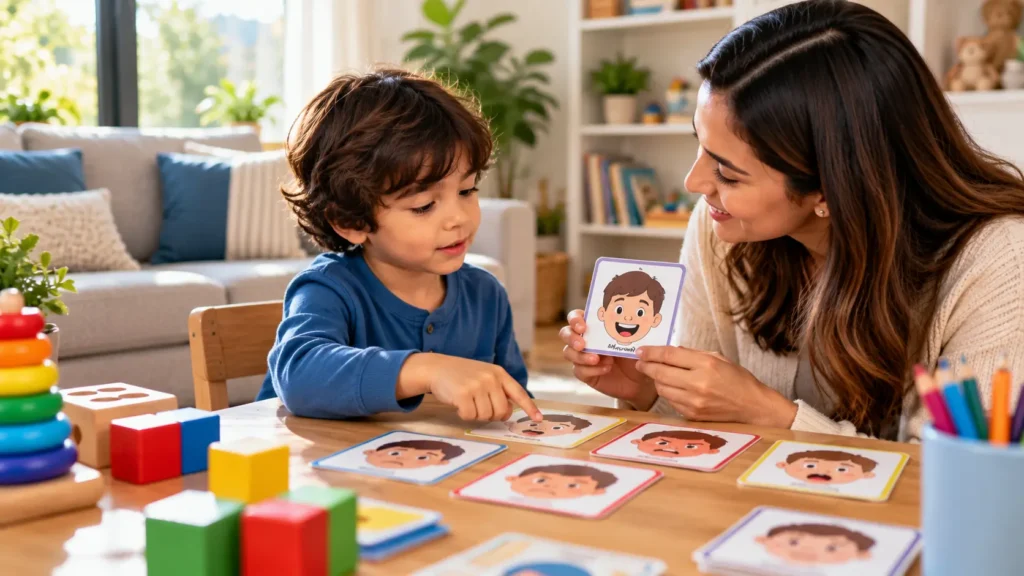
Every morning at 8:10, four-year-old Mateo told his mom the same thing: “My tummy hurts.”
She checked his temperature and took him to the doctor. Nothing was wrong. Yet every morning, as his shoes went on, the tummy ache returned, and by daycare drop-off, Mateo was in tears.
Mateo wasn’t sick. He was worried. He just didn’t have a word for that feeling, so he used the closest one he knew.
For many autistic children, feelings are real and intense, but the path to words is unclear. Emotion flashcards help build that path, and this guide shows you how to use them beyond “happy” and “sad.”
Mateo’s story is a composite based on common experiences from our sessions. Names and details have been changed.
Key takeaways
- Flashcards turn invisible feelings into something a child can see, point to, and name.
- Link each emotion to a face, a body clue, and a calming action.
- Start small, practise when calm, and use the cards in real moments.
Why Feelings Can Be Hard to Name
Naming an emotion takes several skills at once: reading faces, noticing signals inside the body, and linking both to a word. Many autistic children process these signals differently. Some find facial expressions hard to read. Others feel a racing heart or a tight stomach but can’t yet connect it to an emotion. This difficulty, known as alexithymia, is more common among autistic people.
It doesn’t mean a child feels less. When a big feeling has no name, it often comes out as a meltdown, a shutdown, or, like Mateo, a tummy ache.
Why Emotion Flashcards Work
A feeling is gone in seconds, but a card stays still, so your child can study it as long as they need. Cards are also predictable and low-pressure, unlike the question “How do you feel?”
This fits naturally with Applied Behaviour Analysis (ABA), which breaks big skills into small steps and reinforces each success. For many families exploring ABA therapy in Toronto, emotional skills become some of the most meaningful goals, because a child who can name a feeling can also ask for help with it.
The See It, Feel It, Do It Method
Many flashcard guides stop at matching faces. In our experience, progress lasts longer when each emotion is taught in three layers.
See it: recognize the face
Start with two or three emotions that look very different, such as happy, sad, and angry. Real photos, especially of family members, usually work better than cartoons. The right starting point depends on your child’s current skills, which is exactly what our children assessment in Toronto is designed to uncover.
Feel it: connect the body clue
Add one line to each card describing the feeling inside: “When I’m worried, my tummy feels tight.” This was Mateo’s turning point. It linked a sensation he already knew to the word he needed.
Do it: pair it with an action
Pair each card with one calming action, such as squeezing a cushion, taking three slow breaths, or asking for a hug. Now the card doesn’t just describe a feeling. It shows your child what to do with it.
What Happened Next for Mateo
Mateo practised with his cards for a few minutes each evening. His mom named her own feelings out loud, too: “I’m frustrated. The bus is late.”
About six weeks later, instead of saying his tummy hurt, Mateo handed his mom the worried card. They took three slow breaths together, and he walked into daycare with his blue bunny in his backpack.
His daycare kept a matching set, so the same words followed him there. That consistency is the idea behind ABA therapy daycare in Toronto, where a therapist works alongside teachers so support doesn’t stop at the classroom door.
Tips to Make Flashcards Stick at Home
- Practise when your child is calm, not during a meltdown.
- Keep sessions short, around five minutes.
- Name feelings everywhere: in books, shows, and your own day.
- Keep cards where feelings happen, like the front door or the car.
- Celebrate every attempt. Pointing, handing over a card, or using an AAC device all count.
If meltdowns seem to come from nowhere, a qualified behaviour analyst can help uncover why and build a plan around your child.
Frequently Asked Questions
At what age can I start using emotion flashcards?
Many children begin between ages two and four, but readiness matters more than age. If your child can match two identical pictures, they’re usually ready.
Should I use cartoon faces or real photos?
Start with whatever holds your child’s attention, then move toward real photos, which look more like the faces they see every day.
How many emotions should I teach at once?
Two or three that look very different. Add a new one once your child recognizes the first set consistently.
My child is non-speaking. Can flashcards still help?
Yes. Handing over a card is a complete and valid way to express a feeling, and for many children, cards become an everyday communication tool.
Can OAP funding be used for ABA therapy?
Families registered with the Ontario Autism Program (OAP) may be able to use their funding toward ABA services. Our team can help you understand how it applies.
Every Feeling Deserves a Name
Mateo’s mornings aren’t perfect, but they’re different. He has words now, and with words came choices. With patience and the right support, your child can get there too.