Every Saturday, Liam and his dad walked to the Tim Hortons around the corner. And every Saturday, eight-year-old Liam stood quietly behind his dad’s leg while his dad ordered his hot chocolate.
Then one morning, on the walk home, Liam said something new: “Next time, I want to say it.”
It sounds like a small goal. But ordering a drink involves waiting in line, stepping up when it’s your turn, saying the order, paying, and waiting for your cup. For Liam, each of those was its own challenge. Together, they were the difference between watching and doing.
That’s what life skills are really about. Not perfection, but more moments where your child gets to say, “I did it myself.”
Liam’s story is a composite based on common experiences from our sessions. Names and details have been changed.
Key takeaways
- Life skills are learned best in small steps, practised in real places.
- Independence grows when help is faded gradually, not removed all at once.
- The most motivating goals are the ones your child truly cares about.
What Counts as a Life Skill?
Life skills are the everyday abilities that help a child take part in home, school, and community life. They include self-care, like dressing and brushing teeth; home skills, like making a snack or tidying up; community skills, like shopping or ordering food; and safety skills, like knowing their address.
Independence doesn’t mean doing everything alone. It means having more choice and control over daily life. Building these skills is a central part of ABA therapy in Toronto, where goals are chosen around what matters most to each child and family.
Where to Start
Begin with skills your child is motivated to learn and that would make a real difference in your family’s day. It also helps to know which building blocks are already in place. Our children assessment in Toronto looks at your child’s strengths and needs, so goals match what they’re ready for now.
The Independence Ladder
In ABA, help is called prompting, and reducing it over time is called prompt fading. We like to picture it as a ladder your child climbs, one rung at a time:
- Do it with me: you guide each step together.
- Do it beside me: you stay close and help only when needed.
- Do it while I watch: you step back and offer a gesture or a word.
- Do it on your own: your child completes the skill independently.
The key is moving up only when the current rung feels easy. Rushing ahead can turn a skill into a struggle.
Teach the Last Step First
Another powerful ABA method is backward chaining. Instead of teaching a skill from the beginning, you complete every step except the last one and let your child finish it.
With making toast, for example, you put the bread in, wait, and take it out. Your child spreads the butter. Once that’s easy, they take the toast out and spread it. Each time, your child finishes the task and enjoys that sense of success, which keeps motivation high.
Back at Tim Hortons
Liam started at home with a pretend counter on the kitchen table and a small card with his order. His family used virtual ABA therapy in Toronto, so a therapist could guide role-play sessions over video and coach his dad on how to give less help each week.
Then they took it to the real counter, climbing the ladder as they went. First, his dad stood right beside him. Then by the napkins. Then at a table, pretending to read his phone.
About six weeks later, Liam stepped up and said, clearly and proudly, “One medium hot chocolate, please.” His dad says he’ll never forget Liam’s smile on the walk home.
Everyday Tips for Parents
- Choose skills that matter to your child, not just to the checklist.
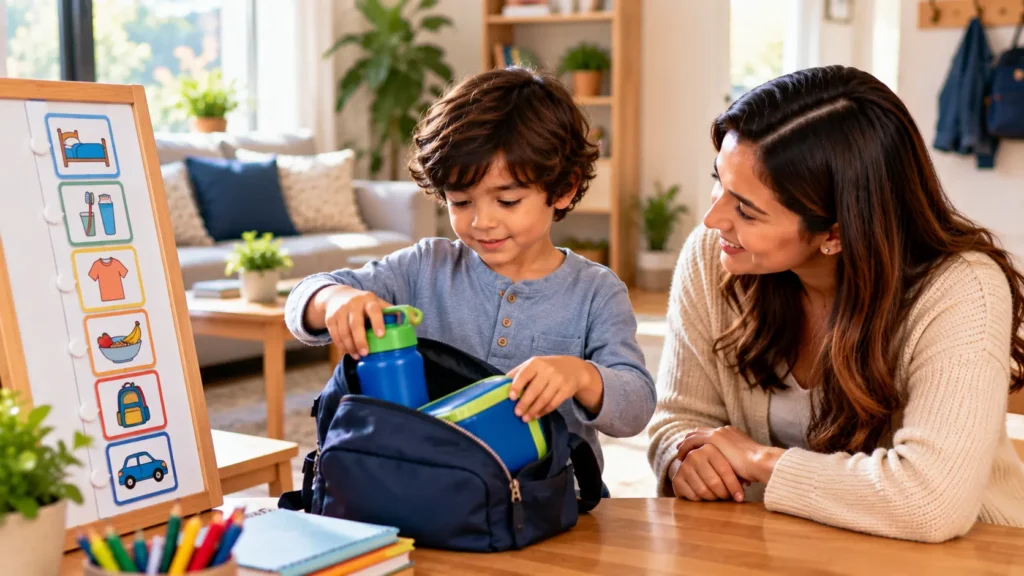
- Break each skill into steps, and use pictures if they help.
- Pause before helping. A few extra seconds gives your child room to try.
- Praise the specific step: “You zipped your jacket all by yourself!”
- Practise in real places, not just at home.
Frequently Asked Questions
At what age should my child start learning life skills?
Right now, at their level. A three-year-old can put socks in a laundry basket, and a ten-year-old might learn to pack their own lunch.
What if my child gets frustrated?
Make the step smaller, give a little more help for a while, and always end on a success.
Is it okay to do things for my child when we’re in a hurry?
Yes. Teach during calm, low-pressure times, and don’t worry about busy mornings when you need to step in.
Can life skills be taught through virtual ABA?
Many can. Dressing, snack preparation, and daily routines happen at home, so a therapist can coach parents through them in the real setting.
Will my child become fully independent?
Every child’s path is different. The goal is the greatest independence possible for your child, with dignity and choice at every step.
Independence Is Built One Step at a Time
Every skill your child learns, from zipping a jacket to ordering a drink, adds to their confidence and their freedom. With patience, small steps, and the right support, those steps add up to a bigger life. When you’re ready, our team is here to help you begin.
This article is for general information and is not a substitute for individualized clinical advice.