
In Omar’s house, winter mornings had a name: the snowsuit standoff.
Every day, the four-year-old was happily lining up his toy cars when his mom said it was time to get dressed. Then came the crying, the running, and the boots kicked across the hallway. Getting out the door took forty minutes, and by daycare drop-off, they were both worn out.
Omar didn’t hate the snowsuit. What he struggled with was the change: stopping something he loved, without knowing what came next, and swapping a warm house for a stiff, scratchy suit.
For many autistic children, transitions like this are among the hardest parts of the day. The good news is that they can be taught, step by step.
Omar’s story is a composite based on common experiences from our sessions. Names and details have been changed.
Key takeaways
- Transitions are hard because they mean stopping, uncertainty, and often sensory change, all at once.
- Predictability is the most powerful tool you have: warnings, visuals, and the same words every time.
- Small, consistent changes at home add up to calmer days.
Why Transitions Feel So Hard
A transition asks a child to do three difficult things at once: let go of an activity they enjoy, cope with not knowing what happens next, and adjust to a new environment that feels different. When all three arrive together, a meltdown is often a sign of overwhelm, not defiance.
For families exploring ABA therapy in Toronto, smoother transitions are one of the most common goals, because they shape every part of the day, from breakfast to bedtime.
10 Practical Transition Strategies
1. Give a warning, then a countdown
“Five more minutes” is abstract. A visual timer is not. Show your child how much time is left, and give a short countdown before the change.
2. Use a visual schedule
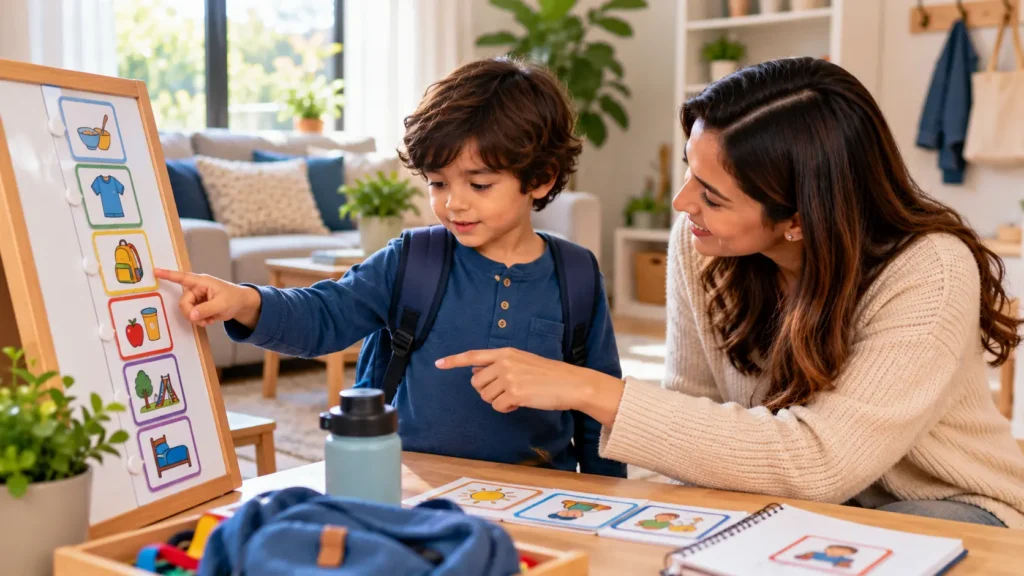
A simple row of pictures (breakfast, snowsuit, car, daycare) answers “what’s next?” before your child has to ask. Visual supports are recognized as an evidence-based practice for autistic learners.
3. Try “first, then”
Pair the harder step with something motivating: “First boots, then the swings.” It turns a stop into a path toward something good.
4. Bring a transition object
Let your child carry something from one activity to the next. For Omar, one toy car “rode along” to daycare, so playtime didn’t have to end completely.
5. Give them a job
“Can you be the door opener?” A small role gives your child a purpose during the change and shifts focus away from what they’re leaving.
6. Offer two choices
“Red mitts or blue mitts?” Choices give your child some control within a transition they can’t skip.
7. Make endings visible
Use an “all done” bin where toys go when it’s time to stop. Seeing the activity finish is easier than having it simply disappear.
8. Mind the senses
Many hard transitions are really sensory ones. Warm the snowsuit by the heater, pick a quiet spot for dressing, or bring headphones to loud places.
9. Practise when it doesn’t matter
Rehearse tricky transitions on a calm weekend, when there’s no rush. Turn it into a game, like a “snowsuit race,” so the routine feels familiar on busy mornings.
10. Stay consistent and celebrate
Use the same words and steps every time, with every caregiver, and praise specific success right away: “You put your boots on so quickly!” Keeping everyone on the same page is a big part of parent coaching in Toronto, because strategies work best when the whole family uses them.
What Changed for Omar
Omar’s family didn’t use all ten strategies at once. They started with three: a visual timer, a “first snowsuit, then car ride” card, and a snowsuit warmed by the heater. A few weeks later, they added his favourite job: “boot captain.”
Within about a month, the forty-minute standoff had become a calm, ten-minute routine. Some mornings are still tough, but now Omar knows what’s coming, and that changes everything.
When to Ask for Extra Support
If transitions regularly lead to intense meltdowns, aggression, or self-injury, or make it hard to leave the house, a qualified behaviour analyst can help identify the cause and build a plan around your child. For younger children, transition skills are often part of early intervention, when routines are still forming.
Frequently Asked Questions
Why does my child melt down when we leave the park?
Leaving means stopping something enjoyable and facing an unknown next step. Warnings, visuals, and a “first, then” card make that moment more predictable.
Should I avoid transitions to prevent meltdowns?
Avoiding change usually makes it harder over time. Small, supported practice helps your child build confidence with change gradually.
How long do transition strategies take to work?
Some families notice a difference within days, while others need several weeks. Consistency matters more than which strategy you choose.
Do visual timers help non-speaking children?
Yes. Visual tools don’t rely on spoken language, so they often work especially well.
What if a strategy stops working?
That’s normal. Look at what has changed, such as sleep or a new setting, and try combining strategies.
Change Is Easier When It’s Predictable
Transitions will always be part of life, but they don’t have to be a daily battle. With patience, predictability, and the right support, your child can learn to move through change with more confidence. When you’re ready, our team is here to help you take the first step.
This article is for general information and is not a substitute for individualized clinical advice.