Five-year-old Zara could recite every station on the TTC’s Line 1, in order, without missing a single stop.
But she couldn’t ask for a glass of juice.
When she was thirsty, she screamed. Her parents would rush to the kitchen and start guessing: water, milk, juice? By the time they found the right answer, everyone was exhausted, and the next afternoon, it happened all over again.
Zara wasn’t being difficult. She was communicating in the only way that reliably worked. That one idea, that every behaviour has a purpose, sits at the heart of the science behind Applied Behaviour Analysis (ABA).
Zara’s story is a composite based on common experiences from our sessions. Names and details have been changed.
Key takeaways
- ABA is built on behavioural science, the study of how learning happens in real life.
- Every behaviour serves a purpose, and understanding it is the first step to teaching a better way.
- Progress lasts when skills are practised at home, with parents as active partners.
What Behavioural Science Really Means
“Behavioural science” can sound clinical, but the idea is simple. It’s the study of why we do what we do and how new skills are learned. ABA applies that science to everyday life, focusing on behaviour that can be observed and measured, so decisions are based on data, not guesswork.
When families begin ABA therapy in Toronto with our team, one of the first tools we use is the ABC model:
- Antecedent: what happens right before. Zara is thirsty, and the juice is out of reach.
- Behaviour: what the child does. She screams.
- Consequence: what happens right after. Her parents rush over and eventually find the juice.
Seen this way, the screaming made perfect sense. It worked. The goal of ABA isn’t simply to stop a behaviour. It’s to teach a new one that works even better.
How ABA Helps in Three Everyday Areas
Communicating: giving every need a better route
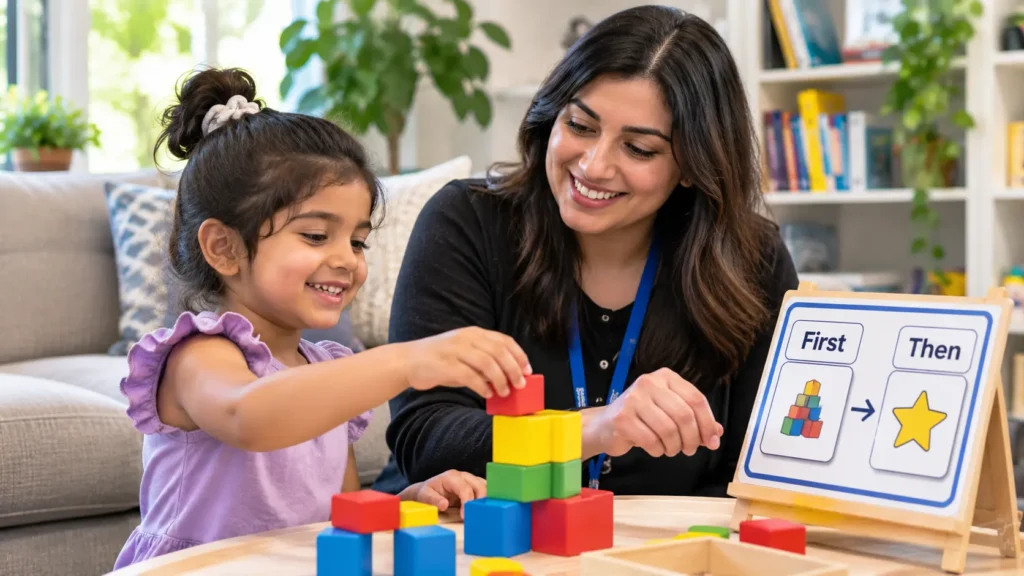
Zara’s therapist taught her a replacement skill: tapping a picture of juice on a small communication board. Each time she tapped it, juice arrived right away. Within a few weeks, tapping had become faster and easier than screaming, so the screaming faded. Later, the picture was paired with the spoken word, and Zara began saying “juice” herself.
Learning: breaking big skills into small stations
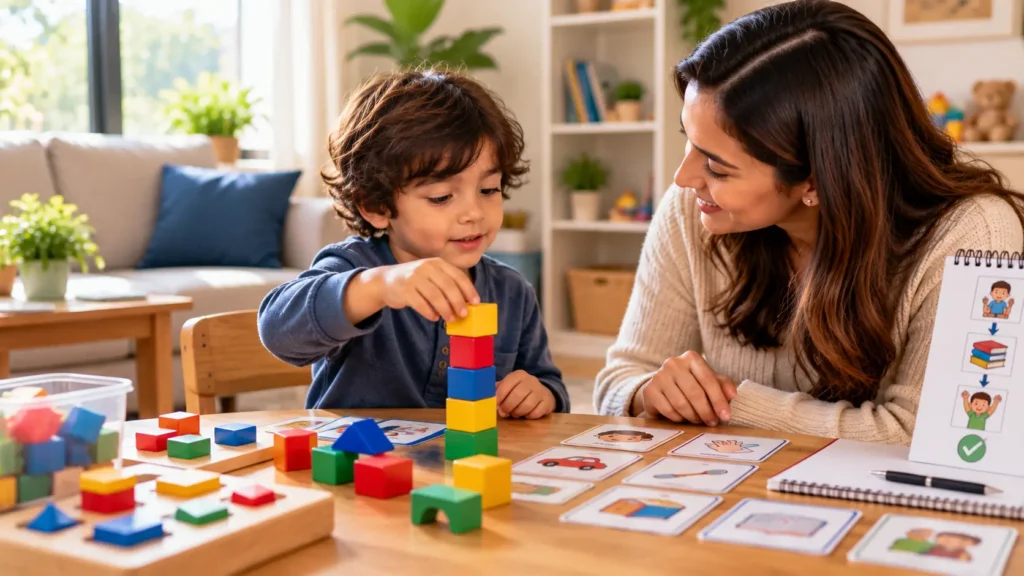
ABA uses a method called task analysis, which breaks a skill into small, teachable steps. Her therapist turned handwashing into a subway line. Station 1: turn on the water. Station 2: add soap. Station 3: scrub while counting to ten. Station 4: rinse. Station 5: dry. Building on Zara’s love of trains made every step meaningful, and soon she was riding the whole line on her own.
Everyday skills: making progress stick
A skill only matters if it works in real life, not just during a session. In ABA, this is called generalization: practising the same skill with different people and in different places until it becomes the child’s own.
Where Zara Is Today
Much of Zara’s progress happened in her own kitchen. Her family chose virtual ABA therapy in Toronto, so a therapist could guide sessions over video, right where the juice and the sink actually were.
Just as important, her parents learned to use the ABC lens themselves. Through parent coaching in Toronto, they learned to spot what came before a meltdown, respond in ways that encouraged new skills, and celebrate small wins. The biggest change, they say, is that they are no longer guessing.
Zara still loves the subway. These days, she also asks for juice, washes her hands on her own, and tells her parents when she needs a break.
What Good ABA Should Look Like
When choosing a provider, look for:
- An individualized plan built around your child’s strengths, interests, and goals.
- Programs overseen by a qualified behaviour analyst. In Ontario, behaviour analysts are regulated by the College of Psychologists and Behaviour Analysts of Ontario (CPBAO).
- Regular progress updates based on data and shared openly with you.
- Sessions your child enjoys, with plenty of play and choice.
- A focus on meaningful, everyday skills, not compliance for its own sake.
Frequently Asked Questions
Is ABA only for children with autism?
ABA is best known for supporting autistic children, but its principles are also used to teach skills to children with other developmental needs.
What is the best age to start ABA?
ABA can help at nearly any age, though early intervention, roughly between ages two and six, often leads to the strongest gains.
How soon will we see progress?
It varies. Some families notice small changes within the first few weeks, while bigger skills take months. Data collected in every session shows exactly what is improving.
Does ABA work online?
For many families, yes. It works especially well when a therapist coaches parents through activities in real time at home.
Can OAP funding be used for ABA therapy?
Families registered with the Ontario Autism Program (OAP) through AccessOAP may be able to put their funding toward ABA services. Our team can walk you through how it applies to your child.
Behaviour Is a Message Worth Understanding
Every scream, shutdown, or repeated question is a child telling us something. Behavioural science gives us a way to listen, and ABA turns that understanding into skills that last. When you are ready, our team is here to help you find where to begin.
This article is for general information and is not a substitute for individualized clinical advice.